Need more water? Meet the WaterBoost Grand range
The high-capacity stored-water boosting solution for large homes, holiday lets, farms, care homes and commercial sites — anywhere a 1,000 litre buffer simply runs out.
Up to 580 l/min at 6.7 bar pressure — twelve models, three tank sizes, four twin-pump sets, single or three phase, all variable speed.
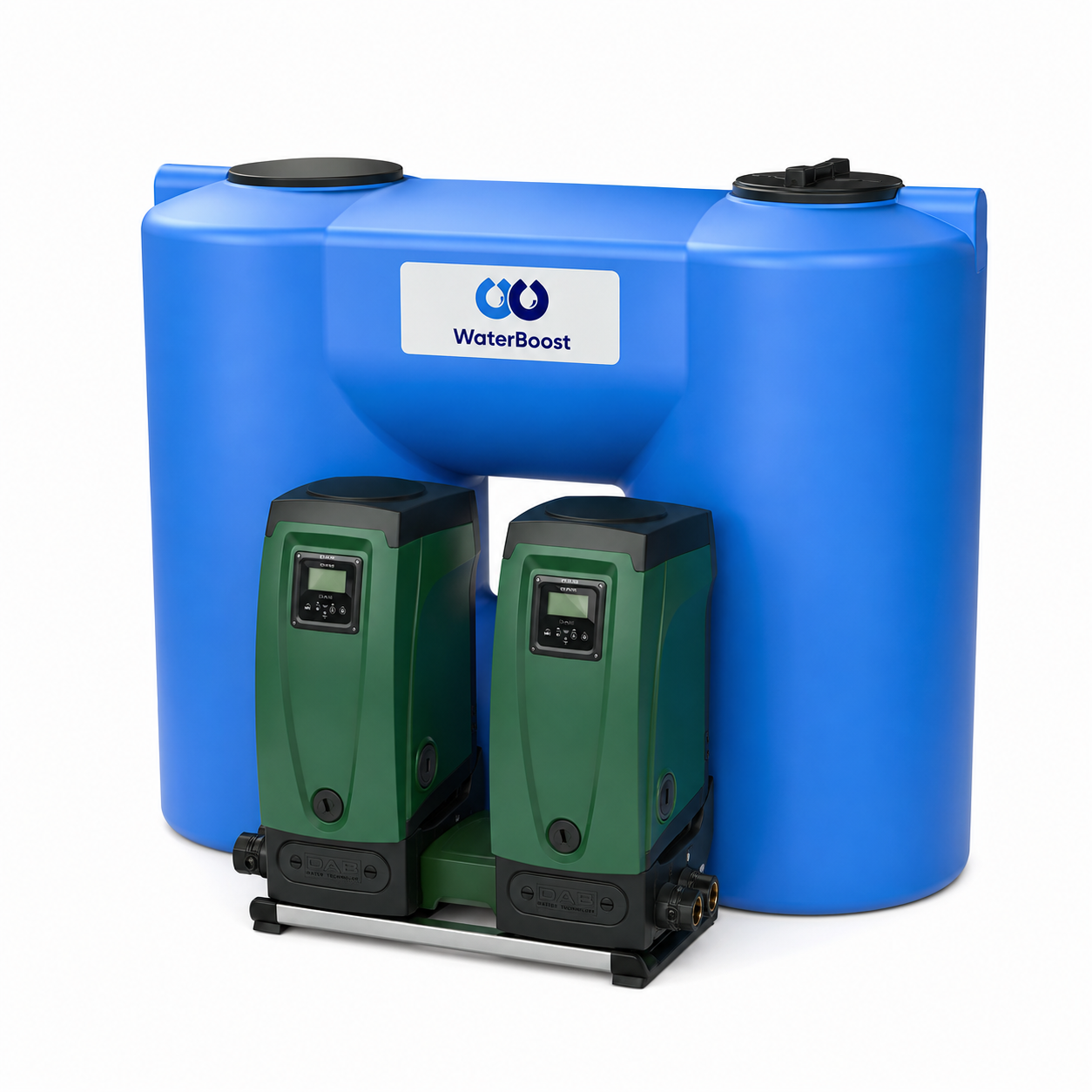
Boosting water in a large or busy property used to mean a compromise. A standard domestic booster runs its tank dry when several bathrooms, a kitchen and outside taps all draw at once — and the alternative, a bulky GRP sectional tank with a packaged pump set, costs thousands more and needs a plant room to put it in.
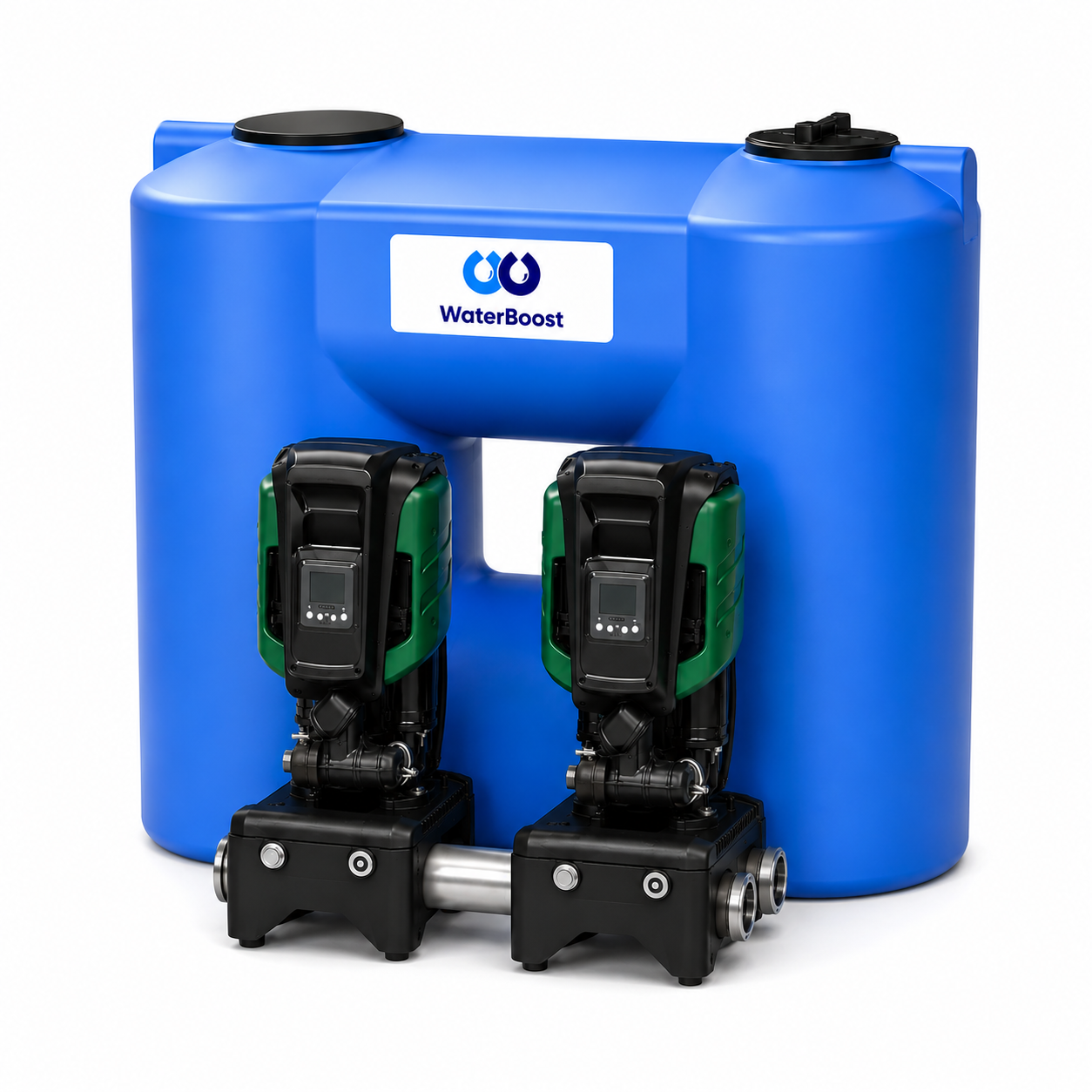
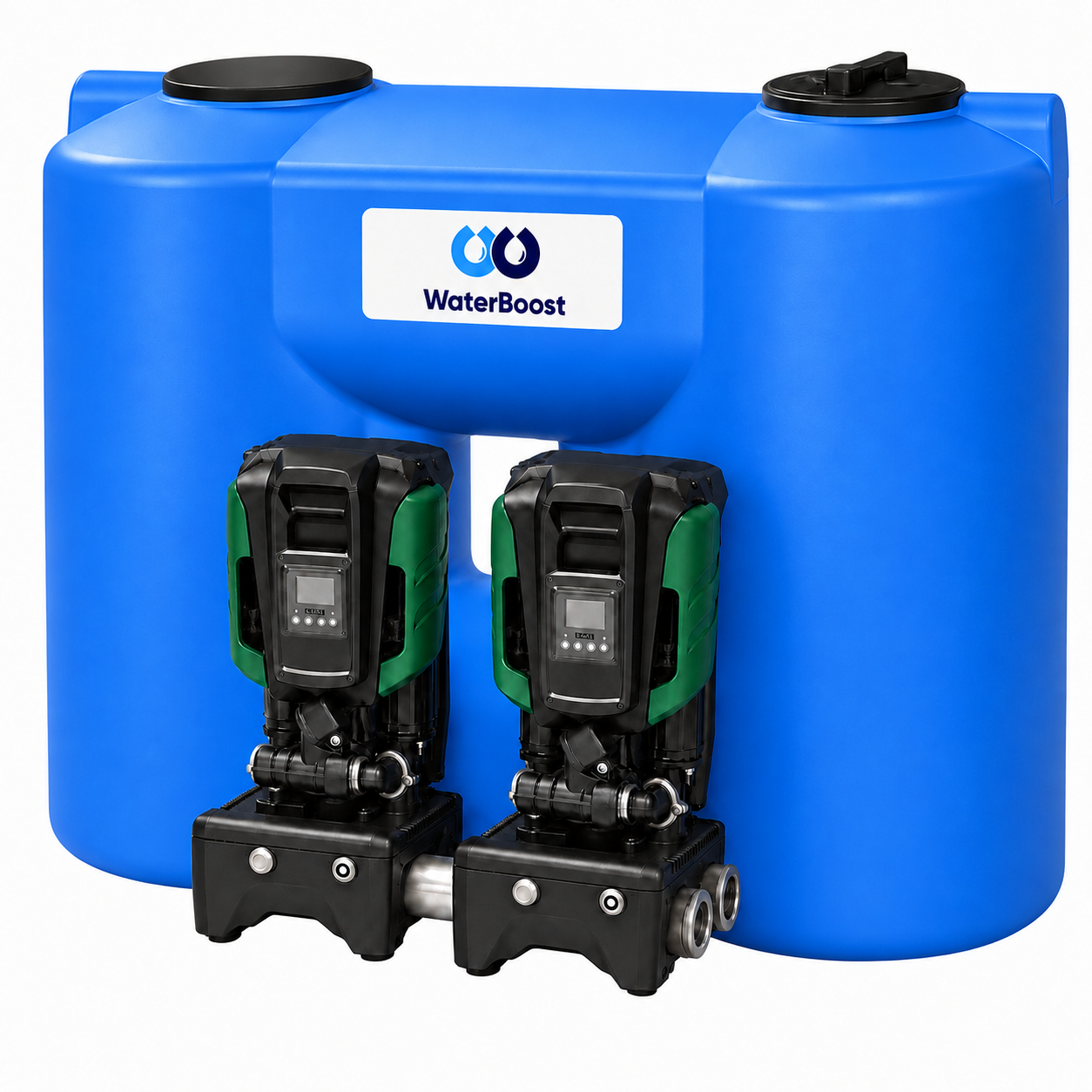
The WaterBoost Grand range is engineered specifically for these installations. A single Enduramaxx slimline tank of 2,000, 3,000 or 5,000 litres — still under a metre wide at the 2000 and 3000 — paired with a twin DAB Esybox pump set, with commercial-grade Esybox MAX and three-phase options for buildings that need real flow and lift.
Our Managing Director, Glen Denny, walks through what makes the Grand range different, how to choose the right tank and pump set, and when a Twin option on the Slim range is the better answer.
What is a Grand booster and how does it work?
A Grand booster is a high-capacity stored-water boosting system built around a single slimline Enduramaxx break tank rather than the smaller upright or linked tanks used in conventional whole-house boosters. The tank fills from the mains via a float valve and By-law 30 fittings, and a twin DAB Esybox pump set draws from the tank to deliver boosted water on demand at constant pressure.
The single-moulding design means the system delivers 2,000 litres and beyond without the interconnecting pipework and joints of a linked pair — a cleaner install, fewer places to leak, and more storage for the floor width. And at 3,000 and 5,000 litres it goes far beyond anything a linked pair can offer.
Why choose a Grand booster?
Which Grand model do you need?
Grand sizing combines two decisions — tank size (how long you can run at peak demand) and pump set (how high and how far you can push the water, and what electrical supply you have). The two are independent, so every pump option is available on every tank. Use this guide to narrow down:
Large homes & holiday lets
3–5 bathrooms, guests, outside taps and appliances all running together.Farms, B&Bs & small blocks
Sustained demand through the day on a weak main; several floors to lift to.Hotels, care homes & commercial
High simultaneous demand, tall buildings, long pipe runs — often with a three-phase supply.Step 1 — choose your tank
Step 2 — choose your pump set
| Twin pump set | Flow @ 3 bar | Max flow | Max head | Supply |
|---|---|---|---|---|
| Esybox Twin | 140 l/min | 240 l/min | 65 m / 6.4 bar | 230 V |
| Esybox MAX 45/120 M | 330 l/min | 480 l/min | 58 m / 5.7 bar | 230 V · 9.4 A |
| Esybox MAX 60/120 M | 420 l/min | 580 l/min | 69 m / 6.7 bar | 230 V · 12.5 A |
| Esybox MAX 60/120 T | 420 l/min | 580 l/min | 69 m / 6.7 bar | 400 V 3φ · 4.4 A |
Currents are per pump. Maximum flow occurs at minimum head — the 3 bar column is the realistic comparison for most installations.
Three-phase 60/120 T sets are also available on the Grand 2000 and Grand 3000. Not sure which pump set you need? Esybox Twin covers most large domestic installs. Step up to MAX where outlets run in genuine simultaneous use across several floors, or where the building is tall.
Designed for a straightforward installation
Every Grand system arrives with the pump set assembled on its dock and the tank fitted with its float valve and overflow. On site it comes down to positioning the tank, connecting mains in and boosted out, and powering up. For installers that means a predictable day rather than a plant-room build; for the client it means a lower install bill.
The one thing to plan is the tank itself. A filled Grand 2000 weighs around two tonnes and the 5000 around five, so all three need an engineered base — a garage slab generally won’t do. Check the access opening before ordering: 1,000 mm for the 3000 and 1,300 mm for the 5000. The 5000 also needs offloading facilities (forklift, telehandler or Hiab) when the pallet arrives.
Send us a photo of the space and the access route and we’ll confirm which tank fits before you commit.
Why twin pumps matter
Every model in the Grand range uses two variable-speed DAB Esybox pumps rather than one larger pump. This matters for three reasons:
Security of supply. If one pump stops — a fault, a service, a blocked filter — the other carries on. For a care home, a guest house or a dental practice, that’s the difference between a maintenance visit and a closed building.
Flow when you need it. Two pumps share peak demand, so morning showers across several floors don’t starve each other. At quiet times one pump idles and the other does the work.
Longer pump life. The pumps alternate duty and run cooler with fewer hard starts. Bearings and seals last longer, and replacement intervals stretch out.
Grand vs Slim Twin — which fits your install?
If you need the security of two pumps but not 2,000 litres or more, the WaterBoost Slim range is available with a DAB Esybox Twin on three tank sizes — same slimline tank, two pumps instead of one. Choose Grand when the install needs:
2,000 litres in one tank rather than two linked 1,000s.
3,000 to 5,000 litres of stored water for sustained demand.
Esybox MAX performance — multi-storey buildings, long pipe runs, many outlets running together.
A three-phase supply you’d rather use, at just 4.4 A per pump.
If 500 to 2,000 litres is enough, the access route is tight (Slim tanks are 400–600 mm wide) and standard Esybox flow covers your outlets, the Slim Twin will usually be the more compact and cost-effective choice.
Need help choosing the right Grand model?
Tell us the number of bathrooms or outlets, the building height, your electrical supply and the space available — our technical team will recommend the right tank size and pump set.
WhatsApp us Get sizing help →