WaterBoost – Grand Range
WaterBoost – Grand 5000L Esybox MAX 45-120M 2705G710
- Established 1975
- Trusted by thousands of customers
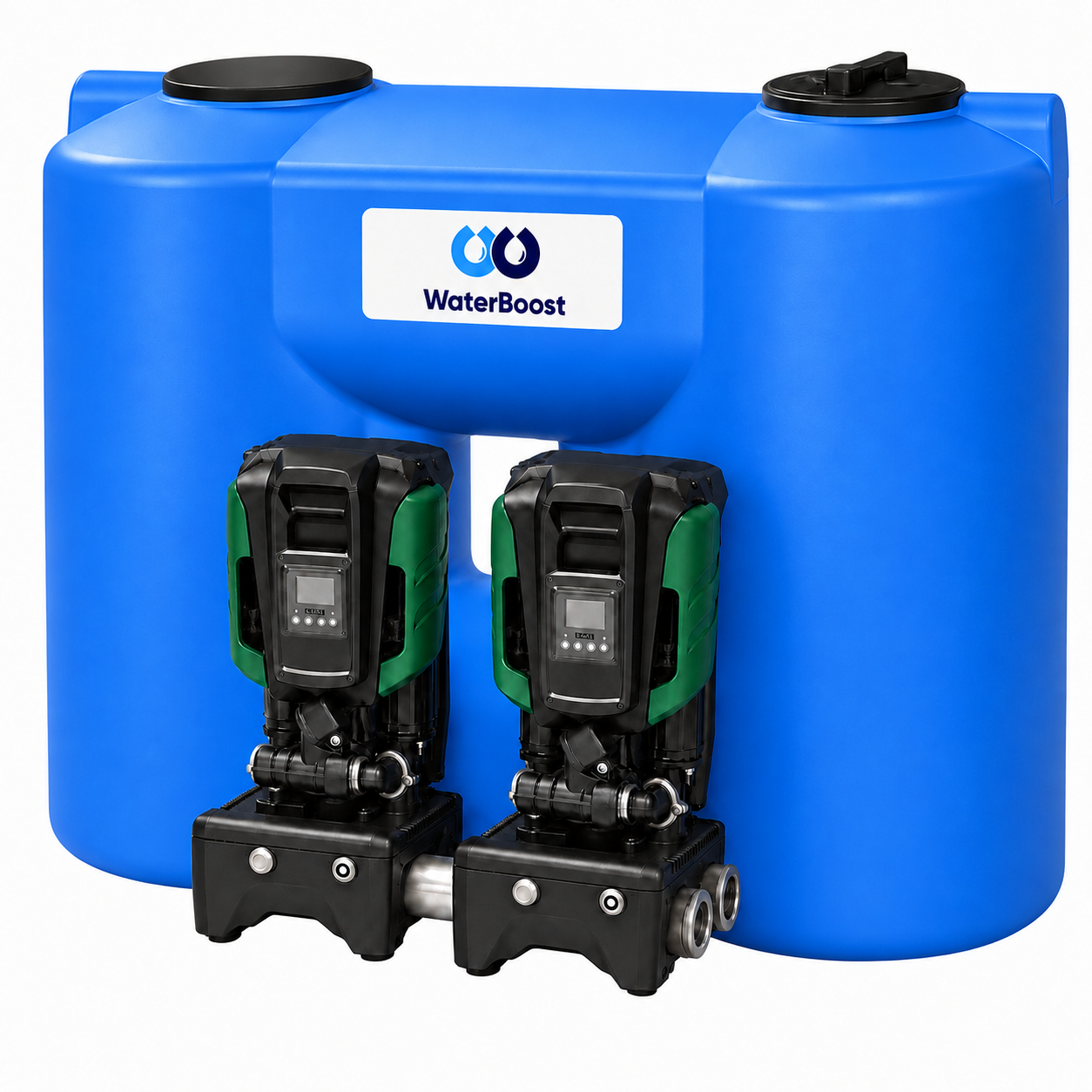
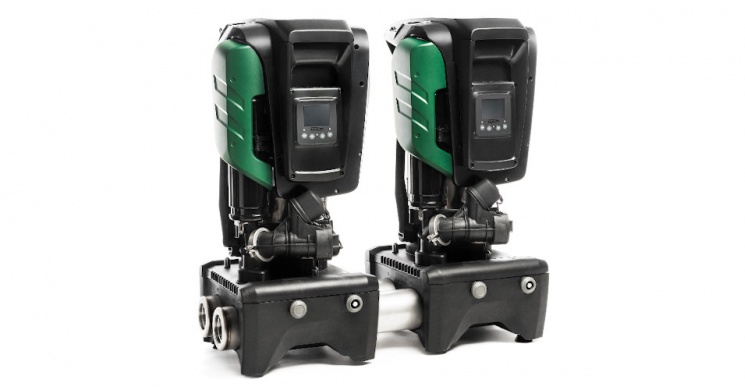
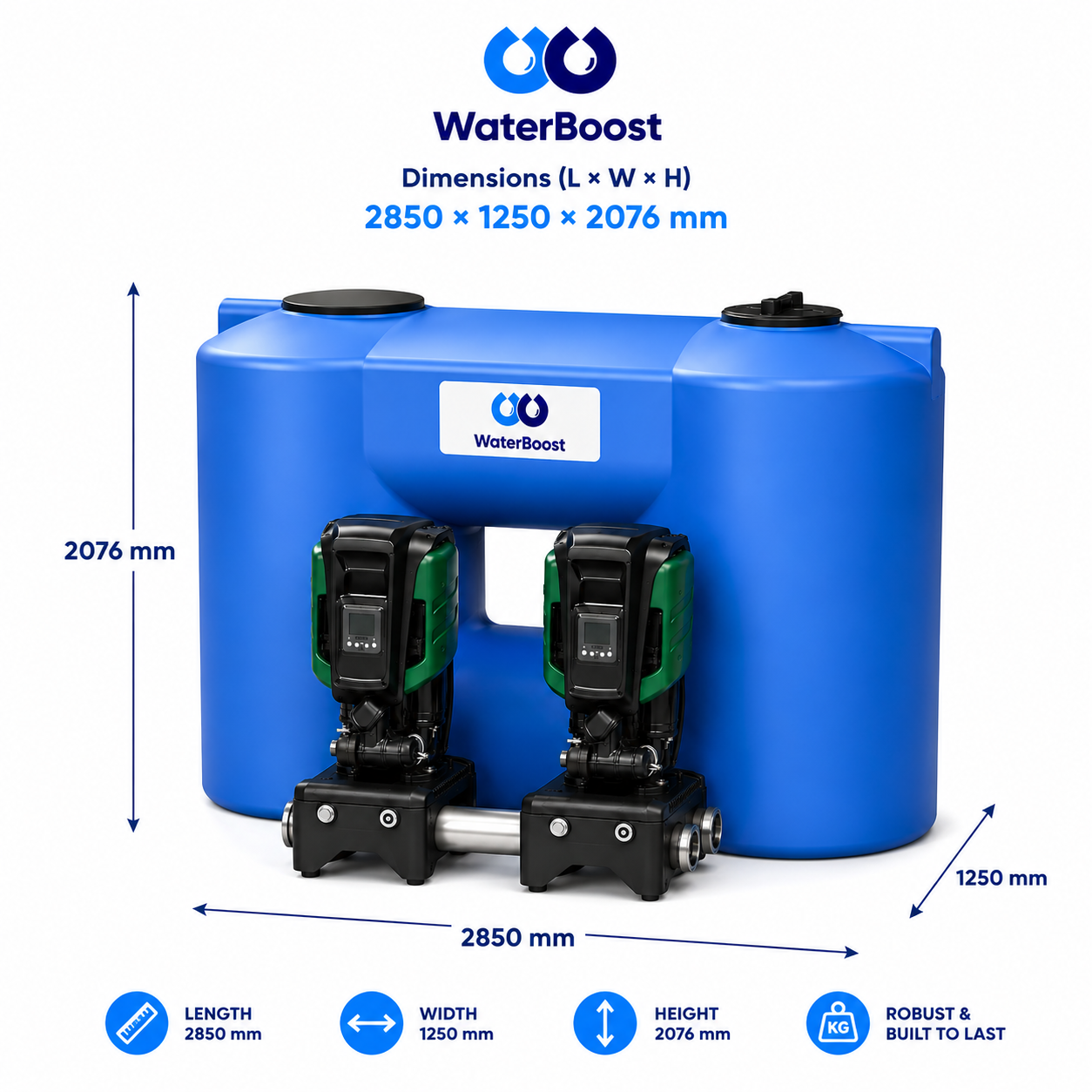
A 5,000 litre slimline break tank paired with a twin DAB Esybox MAX 45/120 M booster set on a 2 Esydock MAX base. The flagship of the Grand range — five tonnes of stored water and commercial-grade flow, all running from an ordinary 230 V single-phase supply.
- 5,000 litres of buffer — enough to ride out a full day of commercial demand on a slow-filling main.
- 58 m constant head held flat to 160 L/min — steady pressure right across normal simultaneous demand.
- 9.4 A per pump against 12.5 A on the 60/120 M — commercial-scale storage without a commercial-scale electrical upgrade.
- Duty/standby plus duty-assist — the second pump joins automatically when demand calls for it, and duty rotates so wear is shared.
- DConnect Wi-Fi built in, with Modbus and BMS interfacing available via the optional esy I/O module.
Established 1975
UK stock
Fast dispatch
More about this product
Overview
The WaterBoost Grand 5000 Esybox MAX 45/120 M is the flagship of the Grand range: a 5,000 litre Enduramaxx slimline tank feeding a twin DAB Esybox MAX 45/120 M booster set mounted on a 2 Esydock MAX base.
Stored water is what makes the system work. Rather than drawing straight from a main that may only manage 20–30 litres a minute, the building draws from a five-tonne reservoir that refills quietly in the background. Peak demand is met from storage; the incoming main only has to keep pace with average consumption over the day.
At this capacity the buffer stops being a smoothing device and becomes genuine resilience. Five thousand litres will carry a small hotel through a full morning of showers, or a care home through a laundry cycle and a lunch service, without the incoming main ever being the limiting factor. It also gives you a real margin if the main is interrupted.
What is unusual is the electrical side. Storage at this scale normally arrives with a three-phase booster set attached. The 45/120 M runs on an ordinary 230 V single-phase supply at 9.4 A per pump — a third less current than the 60/120 M. You give up some pressure ceiling — 5.7 bar rather than 6.7 bar — in exchange for commercial-scale storage on a supply the building already has.
Why this system
Performance
Published DAB duty points for the 2 Esybox MAX 45/120 M set. Curve tolerance to ISO 9906.
| Flow (L/min) | 80 | 160 | 200 | 240 | 280 | 320 | 360 | 480 |
|---|---|---|---|---|---|---|---|---|
| Head (m) | 58 | 58 | 52 | 45 | 38.5 | 32.3 | 26 | 7 |
| Pressure (bar) | 5.7 | 5.7 | 5.1 | 4.4 | 3.8 | 3.2 | 2.5 | 0.7 |
Tank specification
| Enduramaxx 5,000 L slimline | |
|---|---|
| Nominal capacity | 5,000 litres |
| Dimensions (L × W × H) | 2850 × 1250 × 2076 mm |
| Outlet | 2″ BSP |
| Lid | 455 mm vented |
| Overflow | Moulded hoods |
| Material | Polyethylene, UK moulded |
| Filled weight (approx.) | 5,050 kg |
| Guarantee | 10 years |
Pump set specification
| 2 × DAB Esybox MAX 45/120 M | |
|---|---|
| Maximum head | 58 m (5.7 bar differential) |
| Maximum flow | 480 L/min (28.8 m³/h) |
| Constant pressure range | 1–12 bar (3 bar factory default) |
| Power input P1 | 2 × 1.97 kW |
| Nominal current | 2 × 9.4 A |
| Supply | 1 × 208–240 V, 50/60 Hz |
| Nominal pressure PN | 12 bar |
| Maximum inlet pressure | 5 bar |
| Connections | 2″ suction & delivery |
| Protection / insulation | IP X5 / Class F |
| Fluid / ambient temperature | 50 °C / 55 °C maximum |
| Sound pressure | 63 dB(A) at 1 m, free field |
| Set dimensions | 811 × 526 × 766 mm |
| Set weight | 76 kg |
| DAB part codes | 60217358 × 2, 60198332 (dock) |
What’s included & who it suits
- Enduramaxx 5,000 L slimline tank
- 455 mm vented, lockable lid
- Moulded overflow hoods
- 2 × DAB Esybox MAX 45/120 M
- 2 Esydock MAX twin base with stainless manifold
- Integral 2 L expansion vessel per pump
- Non-return valve on each delivery
- Hotels, care homes and large guest houses
- Multi-tenant blocks and mixed-use developments
- Schools, community and leisure buildings
- Farms, equestrian yards and rural estates
- Sites on a severely restricted or slow-filling main
- Commercial and industrial sites with no three-phase
Installation notes
DAB list the Esybox MAX certifications (NSF61, WRAS and ACS) as pending approval in their published catalogues — please confirm current WRAS status with us before specifying for a potable installation. WRAS and Byelaw 30 status for the 5,000 L Enduramaxx slimline tank is likewise to be confirmed. All work must comply with the Water Supply (Water Fittings) Regulations 1999 and BS EN 806.
At roughly 5,050 kg full, this tank requires a properly engineered base pad designed for the load — this is a structural consideration, not a matter of levelling slabs. Allow a minimum 1,300 mm access opening and survey the full route before ordering. Delivery is on the pallet network and offloading facilities are required at site. The electrical supply must be sized for the combined 2 × 9.4 A load and installed by a qualified electrician.
Frequently asked questions
Established 1975
UK stock
Fast dispatch
10 year tank guarantee
-
data sheet PDFDownload
Standard delivery:
Standard delivery is free on most orders. Some items may incur a delivery charge depending on weight, size or value. Any applicable charge will be displayed at checkout.
Deliveries will typically be made between 7am and 6pm, Monday to Friday (excluding public holidays).
Next day delivery:
Next working day delivery is available for a £16.50 + VAT delivery charge.
Orders must be placed before 12 noon to qualify for next working day delivery. Orders placed after 12 noon on Thursday but before noon on Friday will be delivered the following Monday. Orders placed after 12 noon on Friday will be delivered on Tuesday.
Pallet/Large/Difficult items:
Some large, heavy or difficult to transport items may incur an additional delivery charge. Please contact us for a delivery quote before ordering.
Related products

DAB Euroinox stainless steel centrifugal water pump particularly suitable for water supply in domestic installations smallscale agriculture gardening or pressure boosting..
DAB Euroinox MP stainless steel centrifugal water pump particularly suitable for water supply in domestic installations smallscale agriculture gardening or pressure boosting..

The Grundfos CMBE booster is a compact booster system for water supply in domestic applications. The integrated speed controller enables the CMBE to keep constant…
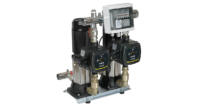
DAB twin AD variable speed booster pump sets specifically suitable for domestic applications and small systems for civil, agricultural or industrial uses.
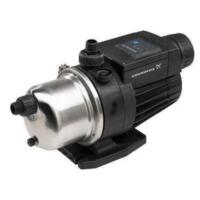
Grundfos MQ3 – Replaced by Scala1 3-35 pipe modifications required If ordered we will send a Scala1 3-35
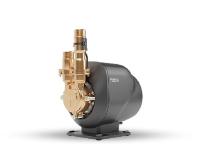

Designed to address the increasing challenge of low mains water pressure, the newly extended STORMBOOST lineup is fully WRAS Approved and now includes six innovative models: STORMBOOST 60, 80,…
Frequently Asked Questions
Quick answers to common questions about the WaterBoost – Grand 5000L Esybox MAX 45-120M 2705G710. For technical specifications, see the product details above; for sizing or installation advice, contact our team. If you have any other questions, we're happy to help.
What is a mains pressure boosting system?
A mains pressure boosting system increases the pressure and flow of water from the incoming mains supply into a property. It typically combines a pump and a storage or expansion tank, drawing water from the mains and delivering it to taps, showers and appliances at a stronger, more consistent pressure. They are used where the incoming mains is too weak to serve modern outlets reliably.
When do I need a mains booster pump?
You normally need a mains booster if static mains pressure is below 1.5 to 2 bar, if showers run weakly when other taps are open, or if combi boilers struggle to deliver hot water. Anglian Pumping recommends checking static pressure at the stop tap before specifying a system, then choosing a model rated for the number of bathrooms and outlets in the property.
What size mains booster do I need for my home?
Sizing depends on the number of bathrooms, the type of fittings and the static mains pressure. As a guide, a 1 to 2 bathroom property with combi boiler or single shower often needs 1.6 to 3 bar boost. A 2 to 3 bathroom property typically needs 3 to 4.5 bar with an integral break tank. Larger homes need a tank-and-pump system such as the DAB Esybox with Esytank or a Powertank set.
What is a water booster pump?
A water booster pump increases the pressure of an existing water supply to give stronger flow at taps, showers and appliances. It can be a small inline pump fitted to the incoming mains, or a larger pump and tank set that draws from a break tank to feed the whole house. Boosters do not create water – they raise the pressure of the water already coming in.
What is the difference between an inline booster and a tank-and-pump booster?
An inline booster connects straight onto the incoming mains and is limited to 12 litres per minute under UK water regulations – examples include the Salamander HomeBoost and WaterBoost WB-Compact. A tank-and-pump booster, such as the Grundfos Home Booster or DAB Esybox with Esytank, draws from a break tank and can deliver much higher flow rates for larger homes with multiple bathrooms.
What is a variable speed booster pump?
A variable speed booster uses an inverter to adjust pump speed in real time to match demand. It maintains constant pressure as outlets open and close, runs more quietly than a fixed-speed pump and typically saves up to 50 per cent of the energy a fixed-speed equivalent would use. The DAB Esybox, DAB Esybox Mini 3 and Grundfos Scala2 are common variable speed examples.