EVAK Drainox range
EVAK Drainox 1500 – 230v

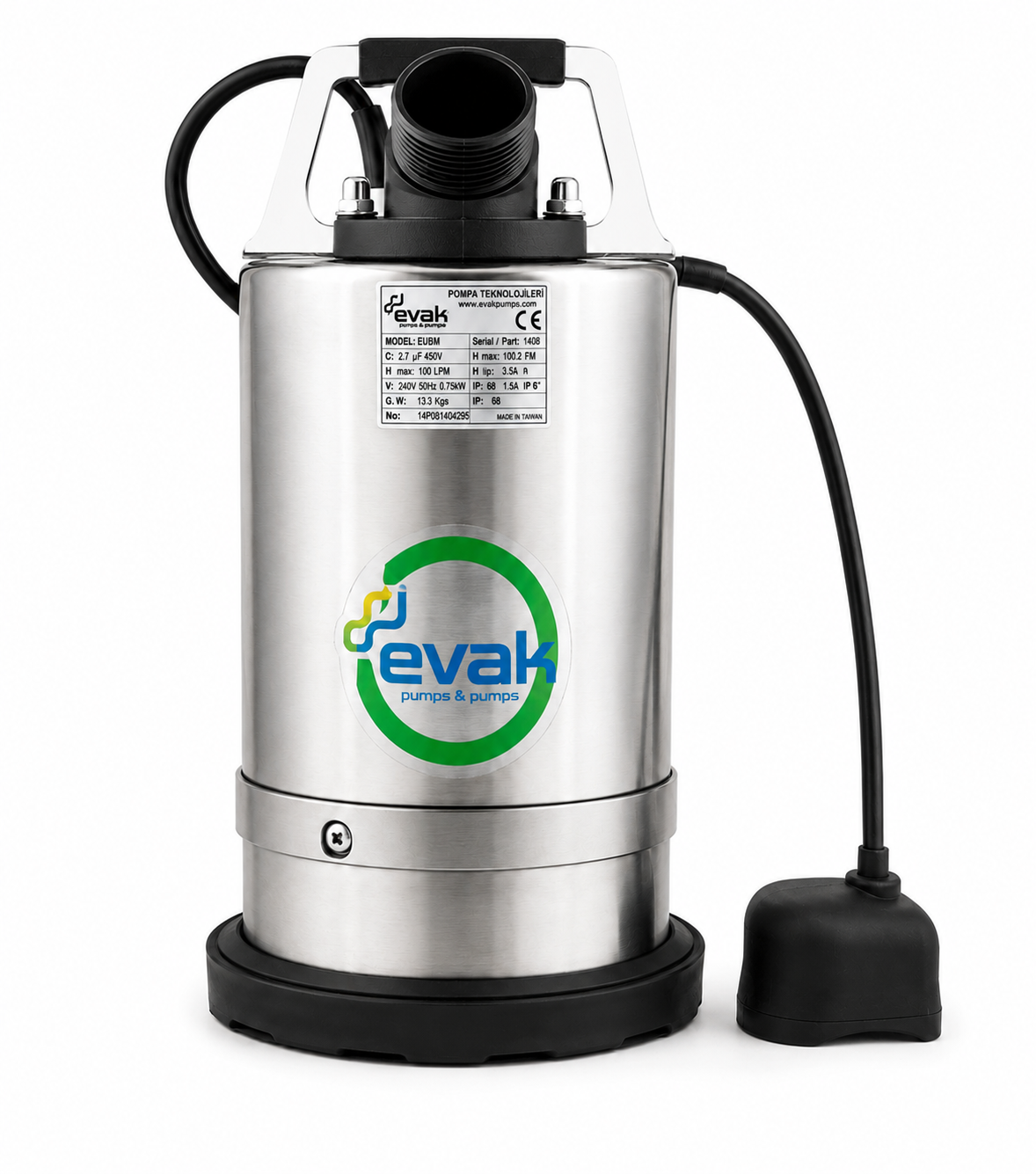
- Established 1975
- Trusted by thousands of customers
The EVAK Drainox 1500 (230V) is the highest-output pump in the Drainox site drainage family – built for arduous dewatering where flow rate and head matter most. Contractor-grade stainless steel and cast iron construction with an added A356 aluminium oil chamber, Hytrel vortex impeller and dual-material mechanical seal (upper CA/CE, lower SIC/SIC) – engineered for extended service life under heavy load.
- Stainless steel strainer base, outer cover and handle
- FC20 cast iron pump housing, ADC12 alloy motor housing, A356 aluminium oil chamber
- Hytrel vortex impeller with 5mm free passage
- 230V single-phase, available in auto (with float switch) or manual
More about this product
Overview
The EVAK Drainox 1500 (230V) is the highest-output submersible site drainage pump in the Drainox range – built for arduous dewatering applications where flow rate and head matter most. Contractor-grade throughout – stainless steel strainer base, cover and handle over an FC20 cast iron pump housing, with an ADC12 alloy motor housing and an added A356 aluminium oil chamber not found on the smaller Drainox models. The Hytrel vortex impeller and dual-material double mechanical seal (upper CA/CE, lower SIC/SIC) are engineered for extended service life under heavy load. Available as 230V Manual for operator-controlled dewatering or 230V Auto for permanent float-controlled installations.
When to Choose the 1500
The 1500 delivers 470 l/min and 19.5m head – significantly more than the 750’s 300 l/min / 15m or the 400’s 225 l/min / 11m. Choose it when volume, head or duty cycle push the smaller Drainox models beyond their design point.
For lighter duties, the Drainox 400 or 750 is usually sufficient.
Key Features
Performance at a Glance
Technical Specification
| Voltage | 230V single-phase |
| Motor rating | 1.5kW (2HP), 2850 RPM |
| Current draw | 12A |
| Operation | Auto (float switch) or manual – select at order |
| Max flow | 470 litres/min |
| Max head | 19.5 metres |
| Free passage | 5mm |
| Discharge | 2″ BSPM with hosetail |
| Seal | Double mechanical seal in oil chamber – upper CA/CE, lower SIC/SIC |
| Motor protection | Auto-reset thermal protector, internal capacitor |
| Cable | 10m H07RN-F |
| Housing materials | Stainless steel strainer base, cover and handle; FC20 cast iron pump housing; ADC12 alloy motor housing and seal casing; A356 aluminium oil chamber |
| Impeller | Hytrel vortex, abrasion resistant |
| Weight | 24kg |
| Dimensions | Diameter 225mm · Height 345mm |
Applications
Large-area civil dewatering, deep sump duties, permanent unattended sump installations, cellar and basement drainage with high inflow rates, commercial site drainage, and any single-phase dewatering duty where flow rate or head is the limiting factor on the smaller Drainox models. The 230V version plugs into standard UK mains and cycles automatically via the fitted float switch (auto variant), making it well suited to permanent installations that need to respond to water level without manual intervention.
FAQs
Standard UK 13A sockets can handle 12A but this is close to the socket’s rating and shouldn’t be run continuously alongside other heavy loads on the same ring. For permanent installations, a dedicated fused spur is recommended – consult a qualified electrician.
Choose auto (float switch fitted) for permanent unattended sump installations where the pump cycles with water level. Choose manual for operator-controlled dewatering where you’ll switch the pump on and off yourself, or where external level controls will be used.
The 1500 uses a dual-material double mechanical seal – CA/CE (carbon/ceramic) on the upper seal and SIC/SIC (silicon carbide) on the lower. The upper CA/CE seal handles the oil chamber side, the lower SIC/SIC handles the pumped water side, giving longer service life under the higher loads a 1500W motor imposes.
No – the Drainox 1500 is only available in 230V single-phase or 400V three-phase. If site-safety 110V supply is required, step down to the Drainox 750.
Standard delivery:
Standard delivery is free on most orders. Some items may incur a delivery charge depending on weight, size or value. Any applicable charge will be displayed at checkout.
Deliveries will typically be made between 7am and 6pm, Monday to Friday (excluding public holidays).
Next day delivery:
Next working day delivery is available for a £16.50 + VAT delivery charge.
Orders must be placed before 12 noon to qualify for next working day delivery. Orders placed after 12 noon on Thursday but before noon on Friday will be delivered the following Monday. Orders placed after 12 noon on Friday will be delivered on Tuesday.
Pallet/Large/Difficult items:
Some large, heavy or difficult to transport items may incur an additional delivery charge. Please contact us for a delivery quote before ordering.
Related products

The Goliath Super is a robust sump pump made of stainless steel plate and fibre-reinforced plastic, resistance to corrosion. It also features a vortex impeller…
Zenit DR Blue Pro 50/2/G32V 230v/1ph Auto DR Blue Professional range of submersible drainage pumps designed for domestic and professional use. Used in cellars and…

The DAB Nova submersible pumps are designed for domestic use including basement drainage, cesspit water removal, ponds and fountains. Ideal for water up to 10…
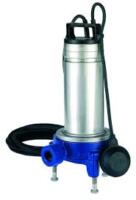

The Lowara Domo GRI is a compact, high-performance submerisble grinder. The heavy duty cutting device makes it excellent for pumping waste water in residential, commerical…
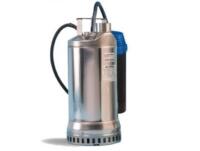
Lowara DIWA pumps Submersible pumps for dirty water manufactured in AISI 304 stainless steel. Four basic models with 0.55 (0.75 HP) to 1.5 kW (2HP) rated power.…
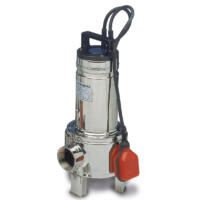
DOMO series, stainless steel electric pumps, are available with twin-channel or vortex impeller (DOMO VX). Designed to handle suspended solids up to 50mm in diameter…
Frequently Asked Questions
Quick answers to common questions about the EVAK Drainox 1500 – 230v. For technical specifications, see the product details above; for sizing or installation advice, contact our team. If you have any other questions, we're happy to help.
What is a submersible pump?
A submersible pump is designed to operate fully submerged in the liquid it is moving. The motor is sealed inside the pump body and cooled by the surrounding water. Submersibles are used for drainage, sewage, septic tanks, deep wells and boreholes, and for raising water from sumps, cellars and floodwater. Many stocked at Anglian Pumping handle solids in suspension.
Can submersible pumps handle solids and sewage?
Yes – some submersibles are designed for clean water only, others handle solids up to 50 mm or full raw sewage. Anglian Pumping stocks ABS, BBC, Flygt and T-T Submersibles ranges that include vortex, single channel and grinder impellers for different solids handling requirements. Always match the pump to the maximum solid size and the type of effluent it will see.
When should I use a submersible pump instead of a surface pump?
Use a submersible when the water level is more than around 8 metres below the pump installation point – surface pumps cannot self-prime beyond that depth. Submersibles are also better when the liquid contains solids, when noise must be minimised, or when the pump needs to operate in confined spaces such as sumps and chambers where a surface pump would not fit.